Thursday, November 11, 2010

Girls Nite Out (1984)

Directed by Robert Duebel
Starring Julia Montgomery, James Carroll, Hal Holbrook, Lauren-Marie Taylor, Al McGuire
Rated R
USA

One of the dozens and dozens of low-budgeted slasher flicks to appear in the wake of Halloween and Friday the 13th, Girls Nite Out failed to attract anywhere near the audiences of those films, and stands as a mostly overlooked entry into the genre.

Those who do remember this one might do so for its having dressed up the killer in a bear costume -- perhaps the only element of the film one might rightly call “original.”

Or they might remember it as having starred Hal Holbrook as Jim “Mac” MacVey, the harried looking campus cop.

Julia Montgomery is here, too, as Lynn, better known for having fallen for a nerd (and appeared on a pie plate) in another 1984 film, Revenge of the Nerds.

Of course, neither Holbrook nor Montgomery could save this amateurish production, mostly interesting for its formula-following, though even there Girls Night Out doesn’t quite fulfill slasher fans’ expectations.

Other expectations aren’t met, either. We might start with the title. While the film does show girls going out at night, that’s about all the title has to do with the story. (Or that poster up above -- none of those women appear in the film.) In other words, it is not as though a group of ladies are on some group outing here.

Nor is the film’s alternate title -- The Scaremaker -- any more accurate. Unless people dressed in bear suits make you scared, in which case the title is spot on.

The movie starts with an ambiguous opening sequence at “Weston Hill Sanitarium.” This scene is mildly alarming for two reasons. One is the nurse smoking cigarettes like she was some cartoon camel or something. (A different time, it was.) The other is a dude hangs himself, although we don’t see his face.

From there comes a quick cut to a college basketball game, accompanied by Tommy James’ “Do Something To Me” to help brighten the mood.

Walking the sidelines as a coach is none other than Al McGuire (R.I.P.), best known as a basketball commentator and for having coached Marquette to the NCAA title in 1977.

McGuire appears here in his first and last dramatic role as Coach Kimble, yelling at his star player, Pete “Maniac” Krizaniac (Mart McChesney) to “get your head out your ass.” Pete subsequently does remove said head from said ass and hits the winning basket, after which McGuire acts his heart out in the locker room while congratulating the team.
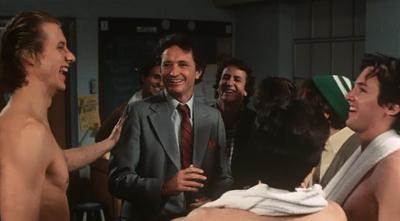

There in the locker room we see Michael Benson (Mathew Dunn) in a bear suit -- the team mascot. Benson is giving one of the players, Mike Pryor, some grief over something, which later we learn probably has to do with the fact that Benson has stolen Pryor’s girlfriend.

Pryor is played by Hal’s son, David Holbrook, and I think he’s the reason why Hal agreed to appear in this stinker. In fact, all of Hal’s scenes were apparently filmed in one day, and aside from a couple of instances doesn’t interact with any of the other cast at all. Instead he spends most of his on-camera time talking on the phone. Like this:


There’s a big party scheduled that night, but before we get to that there comes another ambiguous scene in which a couple of gravediggers are shown apparently trying to bury the body of the fellow who hanged himself, Dickie Cavanaugh. Before they can, a figure leaps out of the dark and kills them, though.

What’s going on? Who cares? Party time. But first, let’s go to the diner for some burgers and shakes!

Teddy (James Carroll) orders from a waitress weirdly named “Barney” (played by the also-weirdly-named Rutanya Alda). That’s where we first glimpse Hal Holbrook, too, as the cop, Mac.

Let’s see... a lot of romantic-entanglement-stuff happening here. We see Pryor and his cheating girlfriend Shelia having an argument. Teddy and Lynn are an item, although he has a wandering eye. Oh, and Pete, a.k.a. “Maniac,” has apparently been dumped by his girl, Leslie.

We get to the party, introduced by an especially energetic (if awkward) dancer. Let the Schaefer flow!


It’s apparently a costume party. Also, there’s a big scavenger hunt scheduled for the next day, an annual event at the college.

We meet a couple more weird characters, and finally most of the slasher elements are in place. A sketchy backstory with some off-campus murders, a few candidates to consider as possibly being the killer, and a bunch of horny, fun-seeking coeds.

To set the stage further, we get more about this Dickie Cavanaugh, an alum who apparently went berserko some years back and killed his cheerleader girlfriend -- the daughter of the campus cop, Mac -- after she dumped him, earning himself a room at the sanitarium. No one knows, apparently, that Dickie has hanged himself.

At the party, a drunk Teddy aggressively flirts with the pretty Dawn Sorenson (Suzanne Barnes), who also is in a relationship. Meanwhile, Benson -- in his bear suit -- is making out with Shelia right in front of Pryor. Finally Pryor flips out, and before a fight breaks out chooses to leave, but not before angrily calling everyone at the party “whores.”

Pretty soon the killings commence, starting with Benson, the killer taking the bear suit afterwards. “Sorry, but I need this more than you do,” says the killer, breathing heavily like any self-respecting slasher would.


By the way, there’s a disc jockey who sorta erratically narrates things throughout the movie, and the next day will be announcing the scavenger hunt clues amid playing the Lovin’ Spoonful’s “Do You Believe in Magic?” over and over again.

Teddy and Lynn are next shown in bed arguing over his problem with flirting. He also has a problem with farting, as he soon demonstrates. I’m not making this up. Apparently he thinks pooting equals personality.

The killer gets a copy of the scavenger hunt clues from the radio station, which I suppose is going to help immensely with the killing.


Also helping with the killing is the nifty, Freddy Krueger-like enhancement the killer has constructed for one of the paws of the bear suit. Yikes!


As the scavenger hunt continues the following day and night, there are more killings. Also of note, Dawn takes a bath:


Flatulent Teddy interrupts Dawn’s bathing, and the two commence an affair. Meanwhile, the bodies are piling up around campus, eventually causing the scavenger hunt to be called off and Mac finally to get involved.

Among the victims is Shelia, played by Lauren-Marie Taylor. She was also a victim in Friday the 13th Part 2, and so should’ve known better than to stand so close to windows.


Once the cops get involved, the film becomes tediously talky as students are interrogated. Here is Julie Montgomery, by the way, whose character Lynn gets questioned (in case you don’t remember her from the pie plate):


Soon we are being shown flashbacks from earlier in the film, in some cases from just minutes before. Really, the most exciting thing during this sequence is this detective’s mustache:


At last we arrive at a sorta-surprising-though-also-sorta-laughable finale which I can’t honestly say delivers much, though after the first 75 minutes the film doesn’t really set one’s expectations all that high, anyway.

With way too many characters (all underdeveloped), lotsa clumsy dialogue, and a plot more convoluted and nonsensical than is generally found even in lesser examples of the genre, Girls Nite Out obviously fails when measured using conventional standards for filmmaking. Even according to the standards of eighties-slashers the film falls short, with no nudity, not much gore, and minimal suspense.

What about camp value? Okay. There is some of that. Worth it, I suppose, if you can bear everything else. (Rimshot.)


- Triple S

Thursday, November 4, 2010

The Teacher (1974)

Directed by Howard Avedis
Starring Angel Tompkins, Jay North, Anthony James
Rated R
USA

“She Corrupted the Youthful Morality of an Entire School!”

That’s the more-than-a-little-overblown tagline of this modest slice of mid-seventies exploitative entertainment. Written and directed by Howard Avedis (listed as “Hikmet” in the credits), responsible for a number of similar sex-and-violence-driven titles of the era, The Teacher presents a fantasy familiar to any schoolboy who ever found himself “hot for teacher.” And -- following the formula of many of these low-budgeted drive-in flicks -- such a fantasy isn’t allowed to play out without consequence.

We begin with the exceedingly creepy Ralph, played by Anthony James, a character-actor who shows up in a lot of films and TV shows of the ’70s and ’80s where thanks to his not-so-good-looks he generally gets cast as a villain. Ralph, alone on the top floor of an abandoned warehouse, grins while crouching over a red coffin. He runs downstairs, hops in a white hearse, then drives to the high school as the students are leaving, their summer vacation having begun.

Ralph follows one of the teachers, Diane Marshall (played by the lovely Angel Tompkins), as she drives her blue Corvette. Eventually he’s back on the top floor of the warehouse, watching through a pair of binoculars as Diane sunbathes topless on her boat on the neighboring lake.


Ralph is weird all right. And a voyeur. But I guess we are, too. Later we learn Ralph has spent time at a VA hospital, the implication being he’s veteran whose returned home with some variety of mental instability.

Ralph’s brother, Lou (Rudy Herrera, Jr.), and his friend, Sean arrive at the warehouse. Sean is played by a perpetually nervous-looking Jay North, the former child actor who starred as Dennis on the Dennis the Menace TV series. They scamper up to the building’s top floor, from which Ralph appears to have disappeared.

Soon they are watching pretty Mrs. Marshall with Ralph’s binoculars, retrieived from the coffin where a rifle, knife, and other items are stored. Amid their sight-seeing, Lou tells Sean that Mrs. Marshall has been “horny ever since her old man left her,” and that she likes Sean, something the latter has a hard time believing.


Suddenly Ralph shows up bearing a large knife, scaring the pair. And just as suddenly, Lou surprisingly falls off the ledge and to his death.


Ralph immediately -- and wrongly -- accuses Sean of causing the accident, which he strenously denies. They tussle a bit, then Sean runs home to his parents, Joe (Med Flory) and Alice (Marlene Schmidt, director Avedis’ wife who regularly appeared in his films), retiring to his bedroom where he can be freaked out alone without having to hear their bickering.

Following a warning from Ralph through his bedroom window, Sheriff Murphy (Barry Atwater) arrives to question Sean about Lou’s death. The sheriff couldn’t be less passionate while still being awake. Sean admits to having been with Lou after school, but offers no details regarding the accident. The sheriff is satisfied and leaves.

The mood quickly shifts as Sean begins his summer vacation, his last before going away to college. The boy has big plans. He’s gonna fix up his van, a project that is going to involve lots and lots of wood paneling.

Those plans eventually get sidetracked, though, as his relationship with pretty Mrs. Marshall -- who lives in the neighborhood -- develops into something more than a simple crush. Cues for this plot turn are loudly signaled, such as when Sean’s teacher invites him inside her house, and when he hesitates she assures him “I’m not going to rape you.”

It’s a predictable turn. But it takes a while, largely thanks to Sean’s reticence. Finally she coaxes him into an awkward kiss.


A little while later, after he’s admitted to her he’s never made love before, she offers to teach him. They fumble a bit more, then make sweet seventies love, although as tends to happen in these flicks, the clothes never do seem to come all of the way off.


A saxophone-laden soundtrack accompanies their lovemaking. Oh, and a miserable-looking Ralph pops by for a glimpse, too.


This scene gets replayed on Diane’s boat, again with Ralph -- in scuba gear! -- coming by for a visit.


As the film moves into the final half-hour, Diane and Sean begin to become more public with their relationship. They go out for dinner together where a couple of old ladies -- played by Katherine Cassavetes (director John Cassavetes’ mother) and Lady Rowlands (mother of Gena, wife of John C. and star in many of his films) -- express distaste at the display.

Their fun continues out to the car, where they are just about to enjoy a drunken drive home when you-know-who arrives. Sean and Ralph scuffle...


...but again, nothing comes of it.

Crazy Ralph is getting majorly pissed. His brother is dead. Sean is making it with Mrs. Marshall. And he has to wear that unattractive yellow jacket everywhere he goes. Never mind the hearse (which never does get explained, by the way).

Understandable, then, why Ralph is so down in the dumps.


Sean and Diane go back to his house where Sean tells his parents the truth about Lou’s death and Ralph’s erratic behavior. They plan to go meet with Alice’s brother, a lawyer, the next day. As they leave, Sean’s father makes him promise to stay in the house until they return.

Of course, moments after they leave, temptation to disobey the order arrives on a tenspeed.


What will happen? Will the creepy Ralph finally cause genuine harm? And what about Diane’s estranged husband -- might he reenter the picture?

The last act does provide a bit of suspense, though overall it continues in the same, somewhat sluggishly-paced vein as does the rest of the film.

The Teacher does have a few things going for it, even if it turns out the teacher only corrupts one dude and not the entire school. Angel Tompkins’ way-above-average hotness is one. Anthony James’ portrayal of Ralph is effective, too. And Jay North does a good job as well as the John Boy Walton-ish, young and innocent Sean.

Still, even if the film does have some historical value in the way it prefigures other, similar coming-of-age titles like Private Lessons, My Tutor, and few others, there ultimately isn’t a heckuva lot that is too memorable here.

Incidentally, check out the last half-hour of Episode 46 of the Movies About Girls podcast to find out what Ken & Mike Demonik thought of this here opus.


- Triple S

Thursday, October 28, 2010

Andy Warhol’s Dracula (a.k.a. Blood for Dracula) (1974)

Directed by Paul Morrissey
Starring Udo Kier, Joe D’Allesandro, Dominique Darel, Stefania Casini, Vittorio de Sica
Rated X
Italy

A Halloween-themed entry for ya.

Appearing in the spring of 1974, Andy Warhol’s Dracula (a.k.a. Blood for Dracula) -- along with its almost-simultaneously-released companion title, Andy Warhol’s Frankenstein (a.k.a. Flesh for Frankenstein) -- probably stands as one of the most-seen or “commercial” of Warhol’s films.

It’s also most certainly one of the wildest, goriest, sexiest entries in the crowded Dracula subgenre of horror.

Of course, while Warhol’s name appears in the title and he is credited as co-producer, it’s more of a branding thing than an indication of the celebrated pop artist’s involvement. Such was the case with many of the later Warhol features. (Sorta like with The Velvet Underground and Nico, one might say.) Here, as elsewhere, writer-director Paul Morrissey is probably best understood as the one most directly responsible for the film’s unique take on the Dracula story.

The film stars German actor and cult film legend Udo Kier in the title role. Joe D’Allesandro, vet of numerous Warhol flicks such as Flesh, Trash, and Heat, co-stars as Mario, disgruntled servant to the Di Fiore family. Also among the cast are Bicycle Thief director Vittorio de Sica as the head of the family, and Maxime McKendry as the Marchese’s wife.

The film opens with an extreme close-up of an ashen-looking Count painting color into his face and hair so as to appear a little less corpsey. Italian composer Claudio Gizzi’s mournful, Erik Satie-ish theme underscores the scene’s melancholy mood.

Thanks to the Count’s servant, Anton (played by the bug-eyed Arno Juerging), we learn the Count is gravely ill, in desperate need of the blood of virgins to subsist. Anton suggests a trip from Romania to Italy where thanks to the influence of the Roman Catholic Church the likelihood of finding the requisite virgins -- consistently pronounced “where-gins” by the pair -- is ostensibly greater.

The two of them hit the road, the Count’s coffin in which he sleeps strapped to the top of their vehicle. A little bit like Aunt Edna in Vacation.


We then look in on the Di Fiore daughters working in the fields. Eventually we learn that after previously thriving, the family has fallen on relatively hard times, now only able to employ the one servant, Mario, and thus having to do things like work in the garden themselves.

Saphiria (Dominique Darel, who sadly died in a car accident just a few years after) and Rubinia (Stefania Casini, who turns up along with Udo Kier in Dario Argento’s Suspiria) decide to disrobe to get more comfortable. Having to do manual labor reduces their status, argues Saphiria, thus making the wearing of clothes seem a luxury. “We are workers and peasants,” she says, “and we might as well start acting the part.”


Sounds reasonable.

After predictably shocking their mother and two sisters, the prudish Esmeralda (Milena Vukotic) and the youngest Perla (Silvia Dionisio), the pair decide to behave and put back on their clothes, having been further encouraged to do so by a somewhat pissed-off seeming Mario.

Cut back to the Count and Anton, now in Italy. At a tavern Anton gathers info about the Di Fiore family. He also just happens to be present when a car accident claims the life of a young girl. The resourceful servant soaks up some of the blood with some bread and brings it back to his master for a tasty treat.


Soon our fun-loving pair arrive at the Di Fiores’ with a story that the Count is looking for a wife. It takes a bit of convincing by his wife, but eventually the Marchese agrees to host them in order to allow the Count a chance to meet his daughters and perhaps choose one as his bride. The Di Fiores view the Count as a means by which to recup the family’s fortune, although we know better.

We also know something the Count doesn’t know, too. Namely, that if he’s hoping to find “where-gins,” he’s destined for disappointment as far as Saphiria and Rubinia are concerned, as they spend that evening taking turns enjoying the family’s studly servant.


Afterwards, the girls tell Mario of the Count and the family’s plans. They promise him a job as a butler at “Palazzo Dracula,” but Mario isn’t interested. In fact, he’s disgusted with the girls’ materialistic thinking, and predicts a revolution such as happened in Russia will soon occur there in Italy. (A hammer and sickle sketched on the wall of Mario’s room later confirms his Marxist leanings.)

The Count meets the four daughters.


Conflict is imminent, as the Count is looking for virgins, but, as Rubinia says to Saphiria, “I never want to marry until I find out what he’s like in bed.”

Saphiria isn’t too crazy about a future with the sickly-looking Count. Mom agrees he’s “deathly pale,” but attributes that to his being a vegetarian. Eventually the Count and Saphiria get to know one another, their meeting mostly involving a most-intrusive interview of the girl by the Count, the goal of which is to find out whether or not she’s ever slept with a man.

When she tells him she’s a virgin, he is initially unconvinced. “Did anyone touch you here... or here... or here?” he probes. And probes. Satisfied with her responses, the Count suddenly proves he’s not a vegetarian after all.


Alas, as we already well know, Saphiria isn’t pure. And thus does the Count find it necessary to send back his meal.


Meanwhile, Mario and Rubinia pass the time making love and discussing class issues. “Right now he’s a disgusting person with money,” says Mario of the Count. “After the revolution he’ll be a disgusting person with no money.” Rubinia nevertheless remains committed to the idea of enjoying the Count’s riches.

They fight some, but ultimately seem capable of overcoming their ideological differences.


Afterwards Rubinia gives her 14-year-old sister Perla a little lecture while she tries to “wash away this peasant smell.” Perla isn’t convinced by Rubinia’s modern views towards sex. Rubinia responds with one of the film’s many campy bits of dialogue:

“As long as you clean and wash yourself up after each one, it’s okay. You just have to smell fresh!”

Rubinia then meets with the Count, and again the meeting mostly consists of Dracula interviewing the Di Fiore daughter about her sexual history. Things seem to be going well between them until Rubinia takes a peek in the mirror into which the Count is gazing.


“You have no refraction!” (It sounds like she says.) Soon Dracula is feasting once more. And once more things don’t go as he would’ve hoped.


Dude’s gonna need a Zantac or something. Seriously. That’s some wicked reflux he keeps having.

The Marchese has to go to London for business. (Actually, it is suggested later he’s going to London to gamble, which started the family’s troubles in the first place.) The Marchesa is left feeling distraught over the failure of her two daughters to satisfy the Count as a possible bride.

A conversation with the Count causes Mario to become suspicious. There remain two more daughters -- both “where-gins” -- but now it is starting to look like a race to see if Mario can get to them before the Count does.


I’ll let you see for yourself how the story ultimately plays out. Some genuine suspense as things race to the end, with a fairly jawdropping conclusion. There’s more sex. And violence. And some blood for Dracula.


While its commentaries on class and/or “modern” decadence are more than a little muddled, the film is nonetheless an entirely entertaining, irreverent take on the genre. The acting is often way, way over-the-top -- especially Udo Kier’s performance -- but clearly intentionally so. There’s enough Dominique Darel and Stefania Casini on display to warrant the “X” rating the original cut received on its premiere. And the audacious, ultra-gory finale should leave most who come to a film like this satisfied.

In the DVD commentary track, Morrissey notes near the end that he enjoys straddling that line between “serious and silly” or “meaningless and meaningful.” Probably as good a place as any to place Andy Warhol’s Dracula.

- Triple S

Nikkatsu Roman Porno Trailer Collection (2010)

Directed by Various
Starring Various
Unrated
Japan

"What kind of crazy hospital is this?"

On November 9, 2010, Impulse Pictures, an imprint of Synapse Films, will release the Nikkatsu Roman Porno Trailer Collection - a remastered archive of 38 Nikkatsu trailers plus a 30 min. short entitled Ryoko's Lesbian Flight.

What is Nikkatsu Roman Porno, you may ask? Allow me to explain. The Nikkatsu Corporation, founded in 1912, is Japan's oldest major movie studio. In 1971, Nikkatsu introduced their "Roman Porno"(which is short for "romantic pornography") line in order to keep afloat, as television had hit the film industry pretty hard by this point. Over the course of their run from 1971 through 1988, Nikkatsu released over a thousand of these "romantic pornography" films, and Impulse Pictures now has rights to many of them; hence, this collection.

Impulse Pictures will be releasing more than 25 full length titles from the "Roman Porno" back catalogue in the near future, but until then, they offer this trailer collection to wet your whistle for what's to come. In this volume, we have over 60 minutes of film trailers that run the gamut from schoolgirl/nurse motifs to bondage, food play - and beyond.
Films of this era can lean on erotosized rape themes a bit, apparently in part as a reaction to the strict censorship laws in Japan at the time and that are still largely in effect today. Sure, you won't see any offensive genitalia, but as a trade-off, you get an increase of torture and sexual assault as arousal material to compensate. Don't get me wrong, rape is not the sole theme in these films, but if titles like "Rape Me", "Rape Shot", "Rape!", or "Rape Apartments" don't tickle your fancy, you may be better off staying clear of this (or simply taking advantage of the skip button on your remote).


On the other hand, if you like Asian cinema - particularly of the erotic variety - you probably already know what you're getting into and will find plenty to enjoy here. The production values of these features are significantly higher than typical soft-core fare, being that Nikkatsu was quite the powerhouse studio at the time, and many of these films were helmed by "legitimate" directors and actors.


It's great that lost or endangered cinema such as this gets another chance to be seen by a future generation and I highly suggest, if your constitution is strong enough, that you pick up a copy of Nikkatsu Roman Porno Trailer Collection and start filling out your wish list today.


Other titles in this collection include: Coed Report: Yoko's White Breasts, Female Gymnastics Instructor: Jump and Straddle, I Love it From Behind!, Nurse's Dormitory: Assy Fingers, Pearl Diver: Tight Shellfish, and The Lovers are Wet.

- Jeremy Vaca

Thursday, October 21, 2010

The Groove Tube (1974)

Directed by Ken Shapiro
Starring Ken Shapiro, Richard Belzer, Chevy Chase, Jennifer Welles
Rated R
USA

Ken Shapiro’s The Groove Tube played something like an “R-rated Saturday Night Live” for most audiences in the late ’70s who probably caught it either as a midnight show, as part of a drive-in double-feature, or for a brief spell in the early ’80s on cable.

While some of the targets of its satire will be unfamiliar to new viewers, the general level of craziness is high enough to sustain interest, with quite a few of the gags still landing despite the film’s age.

After a slow build-up, the first sketch delivers a kind-of-obvious-but-still-grin-producing send-up of the opening of 2001: A Space Odyssey, with a television taking the place of the monolith for a group of spellbound apes.

The opening credits next roll, accompanied by a psychedelic montage of various means of communication culminating with the primary target of this satire -- the almighty TV.


Curtis Mayfield’s “Move On Up” carries us through a postscript with the apes and into the next sketch, one involving a hitchhiker getting picked up by a freethinking, attractive lady driving a yellow VW. Soon they’ve pulled over to the side of the highway, and the lady driver leads our young traveler on a chase through the woods, both happily discarding their clothing along the way.

That little fantasy rapidly resolves into a punchline in which the hitchhiker not only fails to get the girl, but doesn’t seem to have his ID, either.


Next comes “The Koko Show,” a parody of those locally-produced, early-morning kids’ shows some of us recall from the ’70s, a good example of how the TV stood in as an “electronic babysitter.” Only here, the caretaking of the young’uns takes a disturbing turn when Koko (played by Shapiro, who appears in many of the skits) starts reading viewer requests from John Cleland’s Fanny Hill and the like.

A couple of inspired, genuinely laugh-out-loud commercial parodies take us to a longer cooking show segment from the “Kramp TV Kitchen.” Shapiro again stars (from the neck down, in drag) as the hapless cook trying to follow narrated instructions to prepare a Fourth of July Heritage Loaf, “a traditional favorite in Newark.” All goes hilariously awry, gunked up even further by copious coatings of “Kramp Easy-Lube Brand Vegetable Shortening.”

Another commercial parody follows for Geritan, a dietary supplement that appears to have another pleasant effect. This one features a brief appearance by a young Chevy Chase, appearing here with Jennifer Welles, star of various exploitation and porn films in the ’60s and ’70s (including 1977's Inside Jennifer Welles).

Following skits spoofing political roundtable shows and Yellow Pages commercials comes the longest segment, “The Dealers,” starring Shapiro and Richard Belzer as a couple of dope smugglers enduring a sequence of entertaining highs and lows.

Among their hijinks comes an “eat-the-grass-to-hide-the-grass” episode (straight outta “Cruising with Pedro de Pacas”), an impromptu visit to a matinee at which Belzer receives an impromptu blowjob, and a memorably trippy animated sequence.

A commercial for Butz beer then takes us to the “Channel One Evening News” which incorporates more low-budgeted lunacy, including a series of commercials from the Uranus Corporation, makers of Brown 25, a revolutionary new product with “the strength of steel, the flexibility of rubber, and the nutritional value of beef stew.”

“At Uranus, things come out a little differently.”

Next is “Channel One Wild World of Sports” and another inspired bit, coverage of the “The 34th Annual International Sex Games.” The West German team is featured, although the signal “via early bird satellite” could stand to be improved.

A funny bit matching footage of Watergate hearings with Clark Terry’s “Mumbles” comes next, followed by Shapiro and Chase performing an abusive rendition of “Four-Leaf Clover.”

The PSA segment with a strange-looking character with a bulbous head and wrinkly trunk sitting on a park bench informing us about sexually-transmitted diseases that comes next has to be seen to be believed. Sort of analogous to those “magic eye” pictures that once you figure out what is hidden there, you never see it the same way again.

Shapiro then dances us out with a zany song-and-dance number.

Calling The Groove Tube an “R-rated SNL” probably made more sense back during the Chase-Belushi-Murray days. Other points of comparison might include 1977’s The Kentucky Fried Movie (1977), another sketch-comedy based film, or early Firesign Theatre records such as Don’t Crush That Dwarf, Hand Me the Pliers, another satirical work focusing on early ’70s TV.

Despite the inventiveness and promise of his debut, Shapiro would only return for one more feature, the Chevy Chase-vehicle Modern Problems, another comedy remembered fondly by some but which mostly misfired with audiences when released in 1981. Wouldn’t necessarily recommend that one, other than to note it contains one of the most outrageous nosebleed scenes I can remember.

But for some riotous ’70s-style grins -- and a few girls, too -- do put The Groove Tube in the queue.

- Triple S

Wednesday, October 20, 2010

Criminally Insane (1975)

Directed by Nick Philips
Starring Priscilla Alden, Michael Flood, Jane Lambert
Rated R
USA

"My heart is just fine as long as my stomach is not empty."

When a movie has a tagline like "250 pounds of maniacal fury!", one tends to expect something a little out of the ordinary - and for the most part, Criminally Insane (AKA Crazy Fat Ethel) delivers. Running at an easily digestible 61 minutes, sexploitation auteur Nick Philips' (AKA Nick Millard) second foray into the horror genre (the Satanic vampire flick, Satan's Black Wedding being his first) takes quite an interesting twist on terror; that of food addiction and the lengths one will go to satisfy their cravings.

Ethel Janowski (Priscilla Alden) has just been released from an insane asylum where she endured such cruel treatments as electro-shock therapy and forced food withdrawal. Upon her arrival home, Ethel's grandmother, played by Jane Lambert, decides to continue implementing the dietary measures suggested by the doctor at the asylum. Ethel understandably has a problem with this, as food is the only solace she has in her lonely world.


After a few days of misery, Ethel has been driven to the brink of sanity - once again. After her grandmother puts locks on all the cupboards and empties the refrigerator of temptations, Ethel's world spirals out of control as the only thing she truly loves seems to be no more than a distant memory. While arguing with her grandmother, Ethel feels compelled to do whatever is necessary to get access to her precious foodstuffs - which entails stabbing granny to death in order for her to relinquish her grasp of the cupboard key.


With her grandmother now out of the way, Ethel has free access to her gluttonous pleasures. When the food runs low, Ethel takes it upon herself to place the weekly food order from the local grocery. Once the delivery boy shows up and demands payment, of which she cannot make, Ethel has no choice but to stab him to death with a broken bottle so that he won't leave with her box of groceries.


Before the delivery boy's body is even cold, a knock is heard at the front door. As luck would have it, Ethel's prostitute sister has shown up for a visit, leaving Ethel with little choice but to concoct a story of grandma being on vacation. With granny now "gone", Ethel uses her bedroom as a storage room for the rotting corpses that are quickly piling up - using spray air freshener in an attempt to cover up the ever sickening scent of decay.


Who will be the next victim of Ethel's rage, and what will become of their corpses? The only way you'll receive those answers is to get a hold of this puppy yourself for a quick hour of 70's horror goodness.

Retro Shock-O-Rama Cinema brings Criminally Insane, along with it's atrocious sequel, and Satan's Black Wedding to one convenient DVD for your viewing pleasure. The prints are pretty scuffed, but as with most of this type of cinema, it really doesn't matter. The main thing to be thankful for is that these films are even available on DVD at all, and I for one am quite appreciative.


- Jeremy Vaca


LinkWithin

Related Posts with Thumbnails