Showing posts with label Slasher gags. Show all posts

Tuesday, April 10, 2012

House on Sorority Row (1983)

Directed by Mark Rosman
Starring Kate McNeil, Eileen Davidson, Harley Jane Kozak, Jodie Draigie
Rated R
USA

"I'm a sea pig!" 

The 80's didn't really start until 1984. I think Billy Idol really invented the 80's. Before that, it was still the 70's, as evidenced by the clothes and the woeful Cars rip-off band prominently featured in 1983's (relatively) bloodless slasher, House on Sorority Row. The nonsensical premise is, at least, uncomplicated: sorority girls accidentally kill their wicked house mother, then dump her in the pool so they can throw an end-of-semester blow-out party. Things go awry when her body keeps popping up in different spots around the house, and the girls involved in the accidental murder/purposeful cover-up start showing up dead, slashed, seemingly, by the deceased house mother's own metal-tipped cane.


And that's pretty much all there is to it. Of course, there's no reason to just dump the old bitch. It was an accident, a prank-gone-bad, and a call to the local yokel cops would have cleared it all up in an afternoon. Some folks (like Stacey, my wife) could not get past this leap in logic, but hey, who knows what we'd do in similar circumstances? Pools are very convenient places to dump stuff, after all.


Katie (Kate McNeil, one of the several young actresses here who managed to bridge the gap between b-queen and soap star pretty effortlessly) is the token "Final Girl". She's the only one who thinks they ought to call a cop. Sadly, she caves into peer pressure and goes along with the cover-up instead. That's not very plucky. Also, she doesn't have a gender-neutral name. She's pretty much the worst Final Girl ever. At least she wears unflattering work clothes to a drunken blow-out and spurns the advances of her dorky date.


Vicky (future soap star #2, Eileen Davidson) is the ring leader. She's the one that causes the accident in the first place and spends the rest of the movie barking orders to the rest of the girls. Kind of a one-note performance, but effective enough. Also, excellent eyebrows.


Diane (Harley Jane Kozak, soap star #3, third from the left above) is...well, another one of the girls. There's not a lot of characterization at work here. I thought she looked a lot like Marcia Stassman, AKA Mrs. Kotter on Welcome Back Kotter.


Interestingly, Stacey thought Kate was a deadringer from Mrs. Kotter. We were probably just wishing we were watching Welcome Back Kotter instead. Anyway, Harley-Jane is in it, too.


So is Jodi Draigie, who steals the show as the dim-witted blonde-bombshell Morgan. First of all, she has a tremendous look. Her facial features look like somebody was trying to construct the perfect, Dorothy Stratten-esque 80's platinum-blonde glamour queen, but gave up halfway through. For most of the film, she's wearing a crazy "sexy" dress that Melanie Griffith or somebody would have worn to the Oscars in 1982, but no college girl would ever wear, especially to a beer-bash. At one point, after getting smacked in the noggin by the attic stairs, she decides the best course of action (this is is during a raging house party, mind you) is to slip into some flimsy lingerie and take a nap. As a character, she's a completely blank slate (I think she's supposed to be the stupid one?), which is perfect, because Draigie's clearly a non-actor. She only has about three lines, but every one is spat out with an energetic awkwardness that suggests Draigie knew she was over her head, but what the fuck, she's there already, might as well make the most of it.. Draigie/Morgan is the best part of the movie. Too bad she's only in it for about five minutes total.


Oh, can't forget the band, 4 Out of 5 Doctors. Virginia power-poppers with mullets. If you're young and thinking that maybe this band just seems spectacularly lame because they're from the early 80's, I am here to tell you that, even for the early 80's, 4 out of 5 Doctors are off-the-charts, kill-the-hostages, woefully LAME.

Oh, and the killer? Well, at the beginning of the movie, there's a prologue  that takes place 20 years prior. In it, the house mother is extremely pregnant and being cared for by a kooky, sinister "doctor". Clearly, something terrible and gooey is about to happen and there's some yapping about an experiment gone wrong. Very soon after, Katie ends up in the attic of the sorority house, where the house mother has been keeping some unseen kid all these years. This might seem like a spoiler, but it's not, really, because there aren't any other suspects. Not one. No red herrings in sight. So, you know, who else could it possibly be?


In summation: There's a good head-in-the-toilet gag, a flash or two of nubile 80's nudity, and gratuitous Jodi Draigie. Otherwise, House of Sorority Row is mostly tedious, with no mystery, gore, or surprises to recommend it. I actually liked the 2009 PG-rated remake better. And that had nepotism's number one poster girl/block-o-wood Rumer Willis in it, for crying out loud. When Rumer trumps the 80's, you know things are bad.


- Ken McIntyre 

Thursday, December 16, 2010

Pandemonium (1982)

Directed by Alfred Sole
Starring Tom Smothers, Carol Kane, Judge Reinhold, Paul Reubens, Candy Azzara
Rated PG
U.S.A.

Close on the heels of the sudden rise of the slasher genre in the early 1980s came a brief little burst of slasher parodies, remembered by some though largely forgotten. Among the titles in this little niche are Student Bodies (1981), Saturday the 14th (1981), Pandemonium (1982), and Wacko (1982).

Taken together, these flicks might be said to have a couple of things going for them. All appeared well before Scream and a number of other films sometimes regarded as clever, “postmodern” commentaries and/or extensions of the genre. And all enjoy small cult followings, mostly by those who recall airings on the early days of HBO or who watched them as VHS rentals.

These films also all share many of the same failings, too. All more or less adopted the same absurdist approach used by Airplane! (1980) in its send-up of Airport and other disaster films, though without the genuine inventiveness or consistently successful humor. All pretty much tanked at the box office, too, not coming close to the commercial success of many of the films they spoofed. And all were universally panned by critics -- understandably, for the most part.

Of the group, Pandemonium was actually directed by someone who had directly contributed to the slasher genre -- Alfred Sole, whose Hitchcockian thriller Alice, Sweet Alice (1976) stands as a minor classic of the form. Richard Whitley, co-writer of cult fave Rock ‘n’ Roll High School (1979), also had a hand in the script here. And the cast is filled out with several recognizable faces at various stages of their careers, many of whom have a number of well-received performances to their credit.

Ultimately, however, Pandemonium ends up coming off much like the other films in this group, a very amateurish-looking affair with a lot of over-the-top goofiness that mostly misfires, most particularly for audiences coming to the film a few decades after Airplane! and all of its imitators.

The film begins with a melodramatic credits sequence replete with full moon, threatening clouds, and urgent music.


We’re then taken to a college football game (with cheesy, obvious stock footage) involving “It Had to Be U” in Indiana, 1963. Blue Grange (Tab Hunter) scores the winning touchdown, and much celebration follows.

We meet Bambi (Candy Azzara), devoted to Blue though ignored by the football star. She’s also shunned by the five snotty cheerleaders, who are swiftly done away with in a single stroke. Making reference to a halftime salute to vegetables, the cheerleaders are carrying their props single file across the field...


...when someone throws a javelin through all five, an act soon to be described as the “Shish-Ke-Bob” murders in a newspaper headline.

“This must be the act of a maniac,” says a photographer at the scene. “Either that or a very large chef,” replies Phil Hartman in a brief cameo.

More newspaper headlines report further murders of cheerleaders. Then, the backstory sufficiently communicated, we cut to “It Had to Be U... NOW” where Bambi has returned to start her own cheerleader camp. She explains her plans to the maintenance man, Pepe (David Lander, a.k.a. Squiggy), and his mother, Salt, such “exposition” being noted by onscreen prompts.


You get the idea -- we’re being taken through the formulaic steps of a slasher film, with a few more direct borrowings from particular films further signaling the filmmakers’ purpose.

For example, we soon meet innocent Candy -- presented as “Victim #1” -- played by the pixie-like Carol Kane (When a Stranger Calls). Leaving for cheerleader camp, she has a Carrie-like moment with her protective mother (Eileen Brennan), with obvious jokes about “dirty pillows” and such, and Candy revealing her telekinetic powers.


“I just wanna be a normal girl,” says Candy, with Kane employing that cute, baby-like tone for which she is known. And which makes the subsequent lines a touch funnier. “I’m gonna make friends! I’m gonna have fun! I’m gonna go out with boys! I’m gonna sleep with truck drivers and get crabs...!”

We quickly meet the other five “victims,” each introduced in equally farcical set pieces. There’s Glenn Dandy, played by a young Judge Reinhold with his hair dyed blonde. Then comes Mandy (Teri Landrum), Sandy (Debralee Scott), Andy (Miles Chapin), and Randy (Marc McClure).

And, yes, later on they get together and enjoy some candy. Which, in the search to create some more daffy dialogue, comes in quite handy.

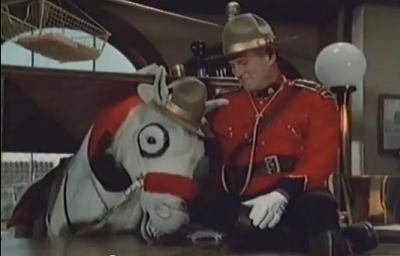
They all journey to the camp via various means, including riding a bus marked “Certain Death.” We’re then introduced to Sergeant Reginald Cooper, played by comedian Tom Smothers, apparently charged with maintaining law and order there at It Had to Be U, Indiana, and its immediate environs.


That he’s a member of the Royal Canadian Mounted Police -- or the “Royal Canadamanadanies,” as he mispronounces it -- riding around on a horse named Bob is never explained. I remember reading somewhere this was meant as an inside joke referring to the fact that many of the slasher pics were filmed in Canada, which I suppose is a bit inspired, if not that funny.

Smothers does his best, though, and produces a few grins during his scenes with Paul “Pee-Wee Herman” Reubens who plays Johnson, an assistant of some kind. They discuss and explore the escape of a man named Jarrett from a nearby mental asylum, a murder-slash-carpenter who is said to have killed his family and made bookshelves out of them.

At the asylum we run into the weird chicken dude from Cheech and Chong’s Nice Dreams (in which Reubens also appeared). Stunning to think this guy somehow found a second opportunity in which to strut his stuff.


Finally everyone gathers at the camp, where further slapstick ensues. The six cheerleaders swiftly segregate into three couples. Glenn Dandy is smitten with Mandy, whose name he tries to guess by covering her nametag.


Sgt. Cooper arrives and apparently is immediately taken with young Candy. They surprisingly break into song (with dubbed operatic voices), one of the few genuinely funny moments in the film.


The craziness continues. The cheerleaders go eat at a diner called House of Bad Pies, served by Crystal and China, played by Candi and Randi Brough -- their real names (no shinola). The twin beauties appeared together in a ton of films and TV shows, and at the time were probably best known for their recurring roles on “B.J. and the Bear.”


All of this silliness has to end, however, as the killer must start claiming victims. Actually the silliness continues even there, with a rapid sequence of supposed-to-be-funny-but-aren't-really improbable kills following. To mention one example, Mandy, who has an irrational (even nauseating) devotion to dental hygeine, meets her end somewhat ironically in a toothpasty mess.


There’s strip poker. A milk (and cookies) bath. Some red herring-like misdirection regarding the identity of the killer. Death by pom pom. Death by megaphone. And lots of eye-rolling double entendres, such as when Andy goes to inspect a troubling noise.

“Do you want me to come with you?” asks Sandy. “Sure, if we time it right,” answers Andy. (Rim shot.)

Soon enough we are left with the Final Girl, Candy, running around in her pajamas.


Sgt. Cooper and his horse Bob turn back up near the picture’s end, too, after seeming to have been riding around in another film for most of the way.


The cast might make this one worth seeking out for some. And as I say, there’s a certain (small) segment who will have some nostalgia for this bit of lunacy. Overall, though, unless your interest in slashers carries you to the point of having to check out all the parodies, too, I wouldn’t necessarily recommend going out of your way for this one.

For me, Student Bodies -- with unforgettable Malvert, the double-jointed janitor -- is the one among this group I like the best, a movie that Ken and Seth reviewed way back in Episode 9. Wacko, directed by Greydon Clark (Black Shampoo, Satan’s Cheerleaders, Joysticks), has its moments, too.

- Triple S

Thursday, December 9, 2010

Axe (a.k.a. Lisa, Lisa) (1977)

Directed by Frederick R. Friedel
Starring Leslie Lee, Jack Canon, Ray Green, Frederick R. Friedel
Rated R
U.S.A.

A claustrophobic slice of semi-sleaze distributed by Z-movie zeitgeist Harry Novak (Kiss Me Quick, Please Don't Eat My Mother), Axe (or, Lisa, Lisa) was filmed in the mid-1970s in Charlotte, North Carolina, at the time still a drive-in hotspot where many exploitation entries tended to play.

Coming in at a little over an hour, Axe is a lean, mean little picture offering a twist on the rape/revenge formula to create a moody, modest cinematic triumph.

The film opens on a starkly-lit leafless tree and farmhouse at sunset, an organ and piano ambling through an unnerving theme as the credits roll. The soundtrack then abruptly switches to cymbals and other percussion as the scene shifts. Hand-held cameras follow three thugs up to one of the top floors of an apartment building located elsewhere.

The trio settles into one of the units to await the return of its inhabitant. There’s Lomax (Ray Green), kind of a Charles Durning-type chomping a cigar; Steele (Jack Canon), maybe looking a little like Robert Pine (the Sgt. from CHiPs); and Billy (writer-director Friedel), whose ’fro and beard make some of us think of Jeff Lynne of the Electric Light Orchestra.

The group explore the apartment a bit, finding a blonde wig and women’s clothing, items that encourage them to refer to the apartment’s inhabitant as a “fairy.”

Genuine suspense builds as they spot from a window the man -- Aubrey (Frank Jones) -- for whom they are waiting. He arrives with a male companion, and soon Lomax and Steele rough up Aubrey while his partner watches in horror.


The beating ultimately proves fatal, and as Steele and Lomax advance on Aubrey’s friend he leaps from the window.

“Why’d he do that? It’s 12 floors?” says Steele. “It’s only nine,” deadpans Lomax.

Soon after the thugs are on the road and looking for a hideout. Billy sits in the back seat, expressing misgivings over what’s happened. They stop at a convenience store, and while Billy waits in the car, Steele and Lomax get unreasonably offended at the poor quality of fruit. They start out throwing apples at the frightened female cashier, then practice skeet shooting with the produce right there inside the store.


“Lady’s got some nice melons, Lomax,” says Steele as they approach the counter. “Maybe she’s got some other nice melons, too?” Once they force her to remove her top, you’re really starting to hate these sadistic-seeming jerks. They try to play a game whereby they make as though they’ll shoot apples off the cashier’s head, William Tell-style.


More abuse follows, then the creeps finally get bored and leave.

As they drive along, frequent crosscutting happens between the trio and the farmhouse from the credits. There we find young Lisa (Leslie Lee), shown gathering eggs and killing a rooster.


By herself she cares for her catatonic grandfather (Douglas Powers), entirely unresponsive as she feeds him a raw egg, then bathes him.

As Lisa slowly performs her duties, she’s nearly as expressionless as her grandfather, seemingly resigned to living out this decidedly morose existence.


When the men arrive, we’re already feeling unsettled, with the scene at the convenience store readying us for more trouble to come. The trio force their way into the house, initially claiming to Lisa, “We don’t mean any harm, ma’am.” Once they discover it is just the young girl and her grandfather, that settles it.

“This place’ll do just fine,” they conclude. (Shudder.)

Policemen soon arrive, and following the thugs’ orders, listless Lisa is able to convince them to leave, after which she feeds the fugitives. Meanwhile, Billy is getting increasingly agitated, and when he tries to run off the other two go after him.

We stay behind with Lisa, alone in a bathroom. She looks in the mirror, then begins to hallucinate -- going mad, it appears.


In this, her only starring role, Leslie Lee manages to exude a genuinely haunting vibe throughout. A moment later she grabs a straight razor and is amid an attempt to cut her wrist when Billy, having snuck back into the house, arrives to interrupt her.

The other two return, and we resume this interesting and tense dynamic. We have Steele and Lomax, killers without consciences and clearly ready to commit further atrocities. There is Billy, caught in between but implicated nonetheless. And Lisa and Grandpa, two seemingly helpless, mostly silent victims-in-waiting.

That the remainder of the film pushes things over into a rape/revenge formula might seem predictable, but the execution (pun intended) from here on out is anything but.


While not as brutal or intense as Last House on the Left, I Spit on Your Grave, or other such films of the subgenre, there remain several stylish -- even uncanny -- sequences that together lift this low-budgeted thriller into something a bit more memorable than your average grindhouse fare.

In other words, Axe should satisfy those of a certain taste.


- Triple S

Thursday, November 11, 2010

Girls Nite Out (1984)

Directed by Robert Duebel
Starring Julia Montgomery, James Carroll, Hal Holbrook, Lauren-Marie Taylor, Al McGuire
Rated R
USA

One of the dozens and dozens of low-budgeted slasher flicks to appear in the wake of Halloween and Friday the 13th, Girls Nite Out failed to attract anywhere near the audiences of those films, and stands as a mostly overlooked entry into the genre.

Those who do remember this one might do so for its having dressed up the killer in a bear costume -- perhaps the only element of the film one might rightly call “original.”

Or they might remember it as having starred Hal Holbrook as Jim “Mac” MacVey, the harried looking campus cop.

Julia Montgomery is here, too, as Lynn, better known for having fallen for a nerd (and appeared on a pie plate) in another 1984 film, Revenge of the Nerds.

Of course, neither Holbrook nor Montgomery could save this amateurish production, mostly interesting for its formula-following, though even there Girls Night Out doesn’t quite fulfill slasher fans’ expectations.

Other expectations aren’t met, either. We might start with the title. While the film does show girls going out at night, that’s about all the title has to do with the story. (Or that poster up above -- none of those women appear in the film.) In other words, it is not as though a group of ladies are on some group outing here.

Nor is the film’s alternate title -- The Scaremaker -- any more accurate. Unless people dressed in bear suits make you scared, in which case the title is spot on.

The movie starts with an ambiguous opening sequence at “Weston Hill Sanitarium.” This scene is mildly alarming for two reasons. One is the nurse smoking cigarettes like she was some cartoon camel or something. (A different time, it was.) The other is a dude hangs himself, although we don’t see his face.

From there comes a quick cut to a college basketball game, accompanied by Tommy James’ “Do Something To Me” to help brighten the mood.

Walking the sidelines as a coach is none other than Al McGuire (R.I.P.), best known as a basketball commentator and for having coached Marquette to the NCAA title in 1977.

McGuire appears here in his first and last dramatic role as Coach Kimble, yelling at his star player, Pete “Maniac” Krizaniac (Mart McChesney) to “get your head out your ass.” Pete subsequently does remove said head from said ass and hits the winning basket, after which McGuire acts his heart out in the locker room while congratulating the team.


There in the locker room we see Michael Benson (Mathew Dunn) in a bear suit -- the team mascot. Benson is giving one of the players, Mike Pryor, some grief over something, which later we learn probably has to do with the fact that Benson has stolen Pryor’s girlfriend.

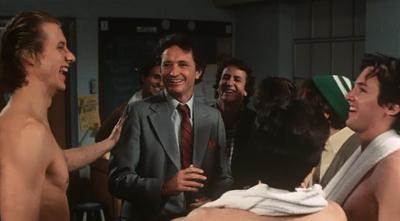
Pryor is played by Hal’s son, David Holbrook, and I think he’s the reason why Hal agreed to appear in this stinker. In fact, all of Hal’s scenes were apparently filmed in one day, and aside from a couple of instances doesn’t interact with any of the other cast at all. Instead he spends most of his on-camera time talking on the phone. Like this:


There’s a big party scheduled that night, but before we get to that there comes another ambiguous scene in which a couple of gravediggers are shown apparently trying to bury the body of the fellow who hanged himself, Dickie Cavanaugh. Before they can, a figure leaps out of the dark and kills them, though.

What’s going on? Who cares? Party time. But first, let’s go to the diner for some burgers and shakes!

Teddy (James Carroll) orders from a waitress weirdly named “Barney” (played by the also-weirdly-named Rutanya Alda). That’s where we first glimpse Hal Holbrook, too, as the cop, Mac.

Let’s see... a lot of romantic-entanglement-stuff happening here. We see Pryor and his cheating girlfriend Shelia having an argument. Teddy and Lynn are an item, although he has a wandering eye. Oh, and Pete, a.k.a. “Maniac,” has apparently been dumped by his girl, Leslie.

We get to the party, introduced by an especially energetic (if awkward) dancer. Let the Schaefer flow!


It’s apparently a costume party. Also, there’s a big scavenger hunt scheduled for the next day, an annual event at the college.

We meet a couple more weird characters, and finally most of the slasher elements are in place. A sketchy backstory with some off-campus murders, a few candidates to consider as possibly being the killer, and a bunch of horny, fun-seeking coeds.

To set the stage further, we get more about this Dickie Cavanaugh, an alum who apparently went berserko some years back and killed his cheerleader girlfriend -- the daughter of the campus cop, Mac -- after she dumped him, earning himself a room at the sanitarium. No one knows, apparently, that Dickie has hanged himself.

At the party, a drunk Teddy aggressively flirts with the pretty Dawn Sorenson (Suzanne Barnes), who also is in a relationship. Meanwhile, Benson -- in his bear suit -- is making out with Shelia right in front of Pryor. Finally Pryor flips out, and before a fight breaks out chooses to leave, but not before angrily calling everyone at the party “whores.”

Pretty soon the killings commence, starting with Benson, the killer taking the bear suit afterwards. “Sorry, but I need this more than you do,” says the killer, breathing heavily like any self-respecting slasher would.


By the way, there’s a disc jockey who sorta erratically narrates things throughout the movie, and the next day will be announcing the scavenger hunt clues amid playing the Lovin’ Spoonful’s “Do You Believe in Magic?” over and over again.

Teddy and Lynn are next shown in bed arguing over his problem with flirting. He also has a problem with farting, as he soon demonstrates. I’m not making this up. Apparently he thinks pooting equals personality.

The killer gets a copy of the scavenger hunt clues from the radio station, which I suppose is going to help immensely with the killing.


Also helping with the killing is the nifty, Freddy Krueger-like enhancement the killer has constructed for one of the paws of the bear suit. Yikes!


As the scavenger hunt continues the following day and night, there are more killings. Also of note, Dawn takes a bath:


Flatulent Teddy interrupts Dawn’s bathing, and the two commence an affair. Meanwhile, the bodies are piling up around campus, eventually causing the scavenger hunt to be called off and Mac finally to get involved.

Among the victims is Shelia, played by Lauren-Marie Taylor. She was also a victim in Friday the 13th Part 2, and so should’ve known better than to stand so close to windows.


Once the cops get involved, the film becomes tediously talky as students are interrogated. Here is Julie Montgomery, by the way, whose character Lynn gets questioned (in case you don’t remember her from the pie plate):


Soon we are being shown flashbacks from earlier in the film, in some cases from just minutes before. Really, the most exciting thing during this sequence is this detective’s mustache:


At last we arrive at a sorta-surprising-though-also-sorta-laughable finale which I can’t honestly say delivers much, though after the first 75 minutes the film doesn’t really set one’s expectations all that high, anyway.

With way too many characters (all underdeveloped), lotsa clumsy dialogue, and a plot more convoluted and nonsensical than is generally found even in lesser examples of the genre, Girls Nite Out obviously fails when measured using conventional standards for filmmaking. Even according to the standards of eighties-slashers the film falls short, with no nudity, not much gore, and minimal suspense.

What about camp value? Okay. There is some of that. Worth it, I suppose, if you can bear everything else. (Rimshot.)


- Triple S

Thursday, October 14, 2010

Massacre at Central High (1976)

Directed by Rene Daalder
Starring Derrel Maury, Andrew Stevens, Robert Carradine, Kimberly Beck, Cheryl Rainbeaux Smith
Rated R
USA

You’re the new kid. You’re buds with one of the members of the innermost, most powerful clique at Central High. But you’re a rebel. A loner. You don’t go for this clique-stuff, no sir.

So what happens? Massacre at Central High, that’s what.

Vets of 70s drive-ins, early 80s cable, or the days of VHS and Betamax may remember this cult classic, the first feature from writer-director Rene Daalder whose credits-listing as “Renee” might cause some to think mistakenly it’s a woman at the helm. (It’s a man, baby.)

Holland-born Daalder got his start working with Russ Meyer (Supervixens, Beneath the Valley of the Ultra-Vixens), who is described on Daalder’s website as the person responsible for the Dutchman’s “initiation in all things American.” (Just imagine that for a moment, if you will.) Sounds like Daalder worked as a cameraman for Meyer and co-wrote an ultimately unproduced script for Meyer as well.

As far as its theatrical life is concerned, Daalder’s low-budgeted drama came and went without a whole lot of fanfare. This despite the praise of several critics including Roger Ebert who cited it as one of the better films of 1976, then heralded it again as a “Guilty Pleasure” a few years later on an episode of “At the Movies,” the PBS version of the show Ebert co-hosted with Gene Siskel. Danny Peary also singled it out for analysis in his second Cult Movies reader.

In the decades since, Massacre has been frequently mentioned as an influential, early example of the ultra-violent high school revenge flick, with several later films -- 1989’s Heathers, in particular -- clearly demonstrating its influence. It’s getting-back-at-the-bullies premise is also sometimes evoked in discussions of real-life high school massacres, most especially the one that occurring at Columbine High in Colorado in 1999.

The title cries exploitative horror, though there’s certainly more going on here than your typical grindhouse fare. It fact, the movie ultimately goes beyond the simple revenge formula to try to present a kind of Animal Farm-type allegory about power and its effect on us. I wouldn’t go so far as to say the film entirely succeeds in advancing some sort of coherent “message” about such. But it does get you thinkin’ -- perhaps more than you might expect to do when watching a film with such a title.


As the opening credits roll, we see the new kid, David, running on the California beach, accompanied by a melodramatic tune declaring “You’re at the crossroads of your life.” Weird “flash-forwards” are intercut here, previews of some of the violence to come.

Soon we’re at school with David, effectively played by a brooding Derrel Maury. With David we witness the three bullies -- Bruce, Paul, and Craig -- in the hall roughing up Spoony, a pre-Revenge of the Nerds Robert Carradine for having drawn a swastika on a locker.

“It’s a social protest,” Spoony explains. “That’s very sixties,” says Bruce, and the rough-housing continues.

That opening exchange does set up what seems like a kind of conflict between an earlier, idealistic time (the 60s) and the more practical, self-interested present (the 70s) where all that “summer of love” crap no longer flies. In any event, David makes a bad first impression when he seems to object to Spoony’s abuse.

Eventually David ends up in a student lounge, a space seemingly ruled by the bullies along with David’s friend Mark, played by Andrew Stevens, a familiar face that fans of movies about girls might remember from 1982’s The Seduction (starring Morgan Fairchild).

Actually, the whole campus is pretty clearly under the bullies’ dominion. It’s a weird world, Central High, where no teachers are ever shown, nor do we meet any parents or other adults for pretty much the entire film.


“This place is a fucking country club,” is how Mark describes the scene to David. “Gotta be able to change your whole style here,” he instructs. “You gotta drop that loner shit.” It’s pretty obvious from the eye-rolls that David isn’t comfortable with his friend’s advice.

The first half-hour rapidly establishes the dynamics of power at Central High while also introducing the female cast. There’s Mark’s girl, Theresa, played by a fetching Kimberly Beck (the final girl in 1984’s Friday the 13th: The Final Chapter). Lani O’Grady, one of the sisters on “Eight Is Enough,” is there, too, as Jane, along with the ever-sweet Cheryl Rainbeaux Smith, the cult-film fave who plays Mary.

The girls are aware of David’s unwillingness to accept the school’s firmly established power structure, but aren’t optimistic he’ll be able to continue to do so for long. As Jane says, “they get to everyone sooner or later.”

David keeps steaming as he watches the fellas rough up more nerds.


Meanwhile, David also laments at the attitude of his friend, Mark, who seemingly endorses such behavior. The nerds don’t care much, either, for David’s attempts at helping them. “Don’t you people ever fight back?” asks David incredulously.

The bullying turns even uglier as the troublesome trio grab Mary and Jane and pull them into an unoccupied classroom for what appears to be an afterschool gangbang. (Again, the viewer wonders, where the hell are the teachers?).


David decides he can’t sit back and watch any longer, and summarily whips all three in satisfying fashion.

Somewhat surprisingly, David and Theresa subsequently enjoy some dimly-lit skinny-dipping at dusk, which Mark finds out about later but doesn’t seem too bothered by. As it turns out, that little bit of fun is but a momentary respite for our protagonist, who soon receives a painful response from the bullies that leaves him crippled.


David tells no one of what happened to cause his now-permanent limp. “Ratting on people is not my style,” he explains. (Of course, in this world without adults it isn’t clear to whom he would do the ratting, even if it were his style.)

No, David’s style involves revenge. The violent kind. The middle third of the film is then taken up with his dealing with the bullies one by one, employing novel, slasher-film-style methods with each.


Along the way, Mark and Teresa make love on the beach (another dusky, hard-to-see encounter), after which Mark wonders if he, too, will fall victim to David’s wrath.

The film does not end with David’s revenge, rather continuing on into a third act, which is why I think critics like Ebert found the film more interesting than your typical drive-in offerings. (That, or perhaps Ebert’s own connection with Russ Meyer predisposed him toward giving the Daalder-directed Massacre more attention than he otherwise might have.)

“What goes around comes around,” says a newly-emboldened Spoony, sort of ironically summing up the new order. One soon realizes that with the bullies out of the way, something not-so-nice seems to be happening to the nerds as a result. “Suddenly this school is rife with opportunity,” says Arthur, who works in the library, as he tries to convince David that the two of them (brawn & brains) can become Central High’s new leaders.

David doesn’t like it. Not one bit. What happens? More nasty surprises.


Oh, and more stuff gets blowed up.


Will leave aside the particulars of how things turn out, other than to point out one much better-lit, campage-a-trois involving Jane, Mary, and Spoony. Spoony’s not such a nerd after all, it seems!


At under 90 minutes, Massacre at Central High gallops along at what to me seems a much-too-fast pace for any deeper messages to be absorbed (or plot twists to be accepted). Still, it's an entertaining ride, as well as a modest achievement with some historical significance. Definitely worth checking out for those with an interest in high school melodrama, “bully comeuppance” flicks, ultraviolence and/or explosions, Rainbeaux Smith, or all things '70s.

- Triple S

LinkWithin

Related Posts with Thumbnails